Cybersecurity Analysis
QTFY Domain Seizures: What QScan and QTRouter Reveal About Proxy Infrastructure and Residual Risk
U.S. authorities say court-authorized domain seizures made QScan and QTRouter inoperable. The joint cybersecurity advisory also shows why defenders must still examine compromised devices, persistent access, control gaps, and the risk that remains after disruption.
By DomyClass
Published
At a glance
- Action date
- The Justice Department and FBI announced the court-authorized domain seizures on August 26, 2026.References:S01S03S04
- Agencies
- The Justice Department and FBI led the seizure action; the FBI, NSA, and Cyber National Mission Force jointly issued the technical advisory.References:S01S02S05
- Affected platforms
- QScan and QTRouter, described in official records as supporting scanning, exploitation, proxying, and traffic obfuscation.References:S01S02S03
- Documented effect
- The Justice Department says the seized hard-coded domains were essential to communication or authentication and that the action made the two named platforms inoperable.References:S01
- Legal status
- The actor, company, and customer relationships in the release and affidavit remain government allegations, not criminal convictions.References:S01S03
- Residual-risk lesson
- Disabling a shared platform does not itself verify that devices, accounts, persistence, or control gaps inside any previously affected environment are gone.References:S02S08
- Research status
- Sources reviewed through August 30, 2026.
What the government actually seized
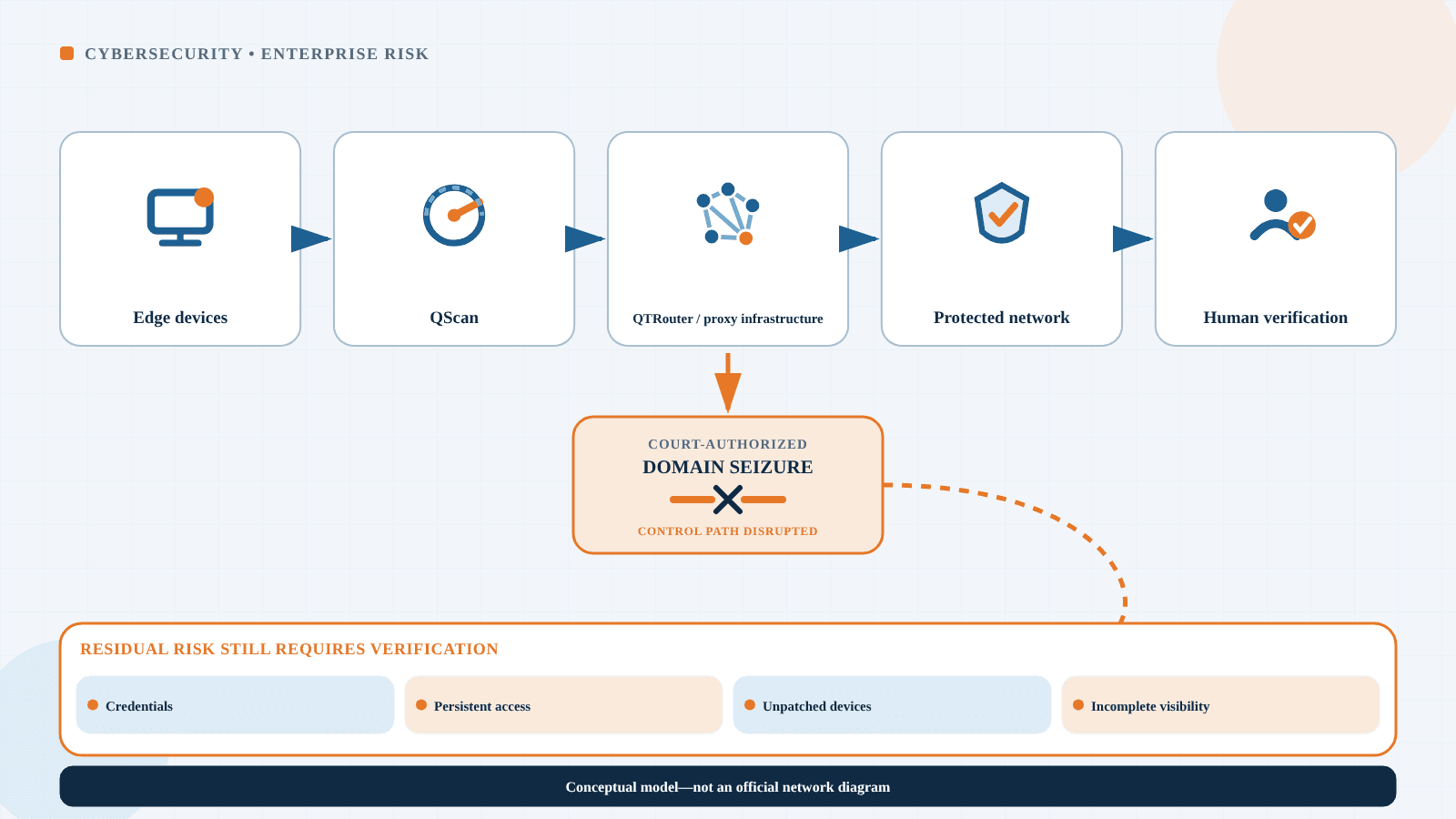
The public action was a seizure of three domain names, not a claim that agents physically collected every server, router, or compromised device connected with the wider activity. The August 24 affidavit asked the U.S. District Court for the Southern District of California to authorize registry-level restraint and transfer. It describes registries locking the names, associating some or all of them with FBI-designated servers, and displaying a seizure notice. Control of a naming dependency can interrupt a distributed service without placing every underlying machine in government custody.
The current Justice Department release was published August 26 and updated August 28. Its update note says edits were made so the page would accurately reflect the government’s allegations in the affidavit. The current page calls listed organizations targets, while the earlier field-office copy used broader victim wording. This article follows the corrected page and treats the affidavit as probable-cause evidence supporting seizure warrants—not as a conviction or final adjudication of the relationships it alleges.
The Justice Department says the action denied access to QScan and QTRouter. The FBI, NSA, and Cyber National Mission Force separately published a joint advisory about QTFY activity, architecture, persistence, and defensive steps. Neither document establishes an arrest, and allegations about actor, company, or state-customer relationships remain attributed to their government source.
What QScan and QTRouter were
At a safe conceptual level, QScan was a distributed system for reconnaissance, vulnerability identification, and exploitation activity. The joint advisory says leased worker servers performed large volumes of tasks and returned results to central services. That explains scale and function without reproducing the exploit inventory, task configuration, endpoints, or operating procedures contained in the technical record.
QTRouter was described by the government as traffic-obfuscation and proxy infrastructure. Its paths drew on compromised Internet of Things devices, commercial proxy services, and leased virtual servers. Relayed traffic could appear to originate somewhere other than the operator’s actual location, including closer to a target. The advisory also separates this obfuscation layer from other systems that managed compromised IoT nodes.
Together, the functions connect reconnaissance with infrastructure enablement: one layer can identify exposed services, another can provide reusable paths that obscure origin, and management layers can maintain node inventories. This defensive model deliberately omits software configuration, access details, routing steps, live infrastructure, and exploit material.
Why the sources use different architecture labels
The records do not offer one interchangeable product map. They describe different observation layers and simplify the system for different audiences. A careful analysis preserves those differences instead of combining every label into an unsupported master diagram.
| Source | QScan | Proxy or relay layer | Management or access layer |
|---|---|---|---|
| DOJ and FBI | Scanning and IoT-infection platform. | QTRouter as an obfuscation network using compromised, commercial, and leased nodes. | The release compresses management and access into a high-level account.References:S01S04 |
| Joint advisory | Distributed scanning, exploitation, and vulnerability-identification system. | QTRouter as traffic-obfuscation infrastructure with several node sources. | Separate botnet platforms manage compromised IoT nodes.References:S02 |
| Black Lotus Labs | Reconnaissance and profiling framework. | Fast Labyrinth as the operational relay mesh. | QTRouter as an access device; QTProxy as node-and-route administration.References:S06 |
Targeting is not the same as compromise
A scan can show that an address or service responded. Targeting can mean an organization was selected for attention. Attempted exploitation describes an effort to use an exposure. Confirmed access, persistence, and data exfiltration are progressively different claims requiring different evidence. Treating the first category as proof of the last would overstate both technical activity and harm.
The advisory’s timeline records several episodes as unsuccessful attempts while using stronger language for other activity. The affidavit gives a clear 2019 example: it alleges that an exploit was directed at NASA, then notes that the relevant system had been patched and the attempt did not succeed. A target was selected; a breach did not follow from that attempt.
Why hard-coded domains created a disruption point
Distributed infrastructure can still depend on centralized services. A domain name can act as a stable reference that software uses to find a service, communicate, authenticate, receive work, or return information even when underlying addresses change. When that reference is embedded into deployed code or configurations, control of the name can become a practical intervention point.
The Justice Department says the seized domains were hard-coded into both platforms and essential for communication or authentication. On that basis, it says the action made QScan and QTRouter inoperable. The affidavit describes registry measures that prevented unauthorized changes and enabled association with FBI-designated servers. This is a documented platform-availability effect tied to the named dependency—not a general claim about every related service or device.
Why disruption is not the same as remediation
The external operation and an organization’s internal incident response answer different questions. One asks whether a shared capability can still function through the seized dependency; the other asks what happened locally, what access remains, and whether recovery is trustworthy.
| Question | What the seizure record supports | What requires victim-side verification |
|---|---|---|
| Platform communication | The named hard-coded dependency was disrupted. | Whether any alternate or reconstituted service is being used.References:S01S03 |
| Compromised devices | No automatic cleaning claim. | Inventory, condition, ownership, firmware, isolation, and trusted recovery.References:S02 |
| Credentials | No universal revocation claim. | Which identities, sessions, secrets, or service accounts require action.References:S02 |
| Persistent access | No universal removal claim. | Whether remote-access tools, web shells, or other channels remain.References:S02 |
| Edge exposure | No universal patching claim. | Which internet-facing and end-of-support devices remain exposed.References:S02S05 |
| Logs and evidence | The operation creates a new investigative time marker. | Local timeline, affected hosts and accounts, and evidence preservation.References:S02 |
| Recovery and monitoring | The shared platform was reportedly made inoperable. | Control validation, residual risk, owner acceptance, and reassessment triggers.References:S02S07S08 |
Proxy infrastructure and the visibility problem
The records describe a mix of compromised consumer or small-office edge devices, commercial proxy capacity, and leased virtual servers. That variety weakens the assumption that hostile traffic will arrive from a stable address block or an obviously foreign location. A request relayed through an ordinary-looking device can inherit a local or familiar network origin without becoming legitimate.
Static IP blocking still has value when an indicator is relevant and vetted, but it is a point control, not a trust model. The advisory says its indicators span historical and current activity and should be investigated before action. Stronger review combines source context with identity, asset ownership, expected behavior, authentication, segmentation, destination, timing, and prior events.
Fielding that context requires ownership. Network teams may see routes and connections, identity teams may see authentication and privilege, application owners may know expected service behavior, and risk owners understand business consequence. A useful detection or escalation process joins those views instead of treating geography as a verdict. This is a defensive visibility problem: the goal is to recognize actions inconsistent with an approved user, asset, and service relationship, not to reverse-engineer or reproduce the relay system.
The persistence problem
The joint advisory says the actors used remote-access tools, web shells, and legitimate credentials from compromised systems to maintain persistence. These are categories of continuing access, not claims that every target had every mechanism. They show why interrupting an external platform and removing access inside an environment are different control objectives.
A blocked infrastructure address does not invalidate an active session, rotate a service-account secret, or determine whether privilege changed. Likewise, a vulnerable edge device remains an exposure until its state, support status, firmware, configuration, and network role are verified. The advisory therefore calls for identifying affected hosts and accounts, isolating when necessary, collecting artifacts and logs, reconstructing a timeline, and coordinating eviction. Recovery becomes credible when an organization can explain what it found, changed, tested, and still does not know.
Sources:S02
Sequence matters. Immediate containment may be necessary to reduce harm, yet a response that changes every system before preserving evidence can make scope harder to establish. The advisory explicitly links threat hunting to countermeasure selection. A disciplined owner records why an action was urgent, which evidence was collected, which paths were addressed, which assumptions remain, and when the environment will be retested. That record supports both technical recovery and later residual-risk decisions.
Defensive controls supported by the advisory
The advisory supports a connected defensive program rather than a single-product answer. Each control has a purpose and a limit.
Maintain the edge
Apply current software and firmware, identify end-of-support devices, and plan replacement. Updating reduces known exposure; it does not prove earlier access never occurred.
Know exposed assets
Maintain an accountable internet-facing inventory and review public applications for operational information. Inventory needs ownership and support state, not only addresses.
Separate critical systems
Use tested segmentation to limit what an edge compromise can reach. A diagram or policy alone does not demonstrate enforcement.
Hunt with context
Review relevant indicators, behavior, identities, and telemetry. Vet indicator age and local meaning before blocking or escalating.
References:S02
Preserve and contain
Collect enough evidence to scope affected hosts, accounts, timing, and techniques while isolating systems when necessary.
References:S02
Plan coordinated eviction
Select countermeasures from observed access and persistence paths, then sequence them so one surviving route does not undermine response.
References:S02
Review identity exposure
Assess credentials, sessions, service accounts, privileges, and recovery dependencies. Network blocking cannot substitute for identity remediation.
References:S02
Validate controls
Exercise detection and prevention, analyze performance, tune people and processes, and repeat. Deployment is evidence of presence, not effectiveness.
References:S02
Defense in depth after an external disruption
For CMIT 320, this case maps defense in depth to complementary functions. Governance names the protected objective and owner. Asset and lifecycle work reduce unknown exposure. Preventive controls patch, harden, segment, and constrain identity. Detective controls look for suspicious behavior. Containment limits consequence; corrective action removes access; recovery restores trusted service; and reassessment tests whether the risk statement changed.
The layers should fail differently and produce evidence for one another. Segmentation can limit movement when prevention fails, while identity monitoring can reveal misuse an IP rule misses. Several products sharing the same identity store, telemetry source, or unmanaged edge device may not provide independent protection. More products do not automatically equal defense in depth; each layer must change the threat path, detect failure, limit consequence, or restore capability, and its operation must be validated.
Translating the case into enterprise risk
ITS 835 adds the business and mission decision. This is a generic risk-record example, not a report about a named organization and not a completed student submission.
| Field | Bounded example | Decision question |
|---|---|---|
| Business objective | Maintain reliable and trusted delivery of a critical digital service. | Which security, safety, or mission outcome matters?References:S07 |
| Risk event | Unauthorized access or disruption through an exposed edge device or obscured relay path. | What event could prevent the objective?References:S02 |
| Cause or exposure | Incomplete inventory, unsupported devices, weak segmentation, identity compromise, or incomplete response scope. | Which conditions make the event plausible?References:S02 |
| Consequence | Service interruption, data exposure, response cost, mission impact, or loss of trust. | Who or what is affected, and over what time? |
| Owner and controls | A named business or mission owner supported by security, infrastructure, identity, and response teams. | Who can accept, fund, escalate, and verify treatment?References:S07 |
| Indicators | Unowned exposed assets, unsupported-device count, anomalous identity events, control-test failures, and overdue response actions. | What evidence shows change or control failure?References:S02 |
| Treatment | Mitigate, avoid, transfer where valid, or explicitly accept within delegated authority. | What response fits objective, appetite, and tolerance?References:S07S08 |
| Residual risk | The credible exposure left after documented controls and response actions. | Who accepts what remains, under which review conditions?References:S08 |
Automation, AI, and oversight
The joint advisory says QTFY actors had been observed researching and integrating artificial intelligence into their processes over the prior two years. That is the full supported detail. It does not identify a model, say which tasks used AI, establish autonomous target selection, attribute a particular compromise to AI, or quantify any change in success.
Sources:S02
The narrow BUSN600 lesson is governance. Automated outputs are not trustworthy merely because they are confident or fast. Organizations need validated data, bounded authority, human review for consequential actions, audit logs, error handling, performance monitoring, and an accountable owner. The same principles apply to AI-assisted defensive tools: a recommendation should be testable, challengeable, and safely overridable.
What the operation does not prove
- The public record does not establish that every organization scanned or targeted was successfully compromised.References:S01S02S03
- The seizure does not establish that every compromised device, credential, remote-access tool, web shell, or alternate channel disappeared.References:S01S02
- The records do not establish that all associated actors, customers, or related infrastructure were identified or removed.References:S01S03
- The documents do not establish that a specific U.S. critical service was controlled merely because its sector or organization was targeted.References:S01S02
- The affidavit is not a conviction, and alleged company or state relationships are not adjudicated facts merely because a seizure warrant issued.References:S01S03
- The action does not establish that future reconstitution is impossible or that incident response inside any previously affected environment is complete.References:S01S02S08
- Residual risk is not automatically zero; it depends on local evidence, controls, response actions, uncertainty, and accountable ownership.References:S02S08
A practical defensive review checklist
After an externally led disruption, use a governed defensive sequence rather than treating the news event as a clean bill of health.
1. Verify exposed assets
Reconcile internet-facing services with accountable owners and approved purposes.
References:S02
2. Check device support
Identify supported and end-of-support edge devices, firmware state, and replacement plans.
References:S02
3. Review telemetry
Evaluate relevant behavior and vetted indicators across the evidence-based review period.
References:S02
4. Preserve evidence
Collect enough logs and artifacts to understand scope before disruptive remediation destroys context.
References:S02
5. Scope identities and hosts
Identify affected devices, accounts, sessions, privileges, and dependencies.
References:S02
6. Isolate affected systems
Contain credible exposure while preserving safe investigative and recovery paths.
References:S02
7. Patch or replace
Correct vulnerable infrastructure and remove unsupported components from exposed roles.
8. Test segmentation
Verify that edge systems cannot reach critical services beyond approved need.
9. Validate controls
Exercise preventive and detective controls and investigate gaps in people, process, and technology.
References:S02
10. Assign residual risk
Document the remaining scenario, owner, treatment, uncertainty, and acceptance authority.
11. Define indicators
Choose measures that reveal coverage, exceptions, response delay, control failure, or reconstitution.
12. Reassess on change
Review the decision when assets, threat evidence, control performance, ownership, or business impact changes.
Related DomyClass resources
These resources extend the article’s defensive network-security, enterprise-risk, and bounded automation-governance concepts. The linked institutions did not participate in preparing this analysis.
Sources and methodology
DomyClass reviewed the cited government records, cybersecurity advisory, court affidavit, and defensive guidance directly. Allegations are attributed to their source, and the article does not reproduce exploit instructions or a bulk list of technical indicators.
Sources reviewed through: August 30, 2026
- S01Justice Department and FBI Seize Platforms Operated and Used by China State-Sponsored Hackers to Target U.S. Critical InfrastructureU.S. Department of Justice, Office of Public AffairsU.S. government releasePublished August 26, 2026Updated August 28, 2026Reviewed August 30, 2026
- S02China-Linked Hacking Group QTFY Targets Military and Critical Infrastructure with Malicious Distributed SystemsFederal Bureau of Investigation, National Security Agency, and Cyber National Mission ForceJoint cybersecurity advisory, JCSA-20260826-01, initial versionPublished August 26, 2026Reviewed August 30, 2026
- S03Affidavit in Support of Applications for Seizure WarrantsU.S. District Court for the Southern District of California; redacted FBI Special AgentCourt affidavit supporting seizure-warrant applicationsPublished August 24, 2026Reviewed August 30, 2026
- S04Justice Department and FBI Seize Platforms Operated and Used by China State-Sponsored Hackers to Target U.S. Critical InfrastructureFBI San Diego and U.S. Attorney’s Office, Southern District of CaliforniaOfficial agency release; current FBI route redirects to the U.S. Attorney’s Office copyPublished August 26, 2026Reviewed August 30, 2026
- S05NSA Joins FBI in Issuing Warning about Chinese Hacking Group QTFY Cyber ActivityNational Security AgencyOfficial agency statementPublished August 26, 2026Reviewed August 30, 2026
- S06The Infrastructure Quartermaster: Inside a China-Nexus State Enablement ModelDamon Rouse and Steve Rudd, Black Lotus Labs; technical editing by Ryan English and Mike HorkaIndustry threat-intelligence analysisPublished August 26, 2026Reviewed August 30, 2026
- S07NIST Cybersecurity Framework 2.0National Institute of Standards and TechnologyOfficial risk-management guidancePublished February 26, 2024Reviewed August 30, 2026
- S08Residual Risk — CSRC GlossaryNational Institute of Standards and TechnologyOfficial sourced risk terminologyReviewed August 30, 2026
Sources reviewed through August 30, 2026. The article distinguishes the government’s stated platform-disruption effect from the separate verification required inside an affected environment. Contact DomyClass to suggest a correction.
Get Help With CMIT 320 Network Security at University of Maryland Global Campus
Get targeted CMIT 320 help and improve your grades.
Get CMIT 320 Help