Study Guide
UNC STOR 155 Study Guide: Topics, Difficulty, Exam Preparation, and STOR 120 Comparison
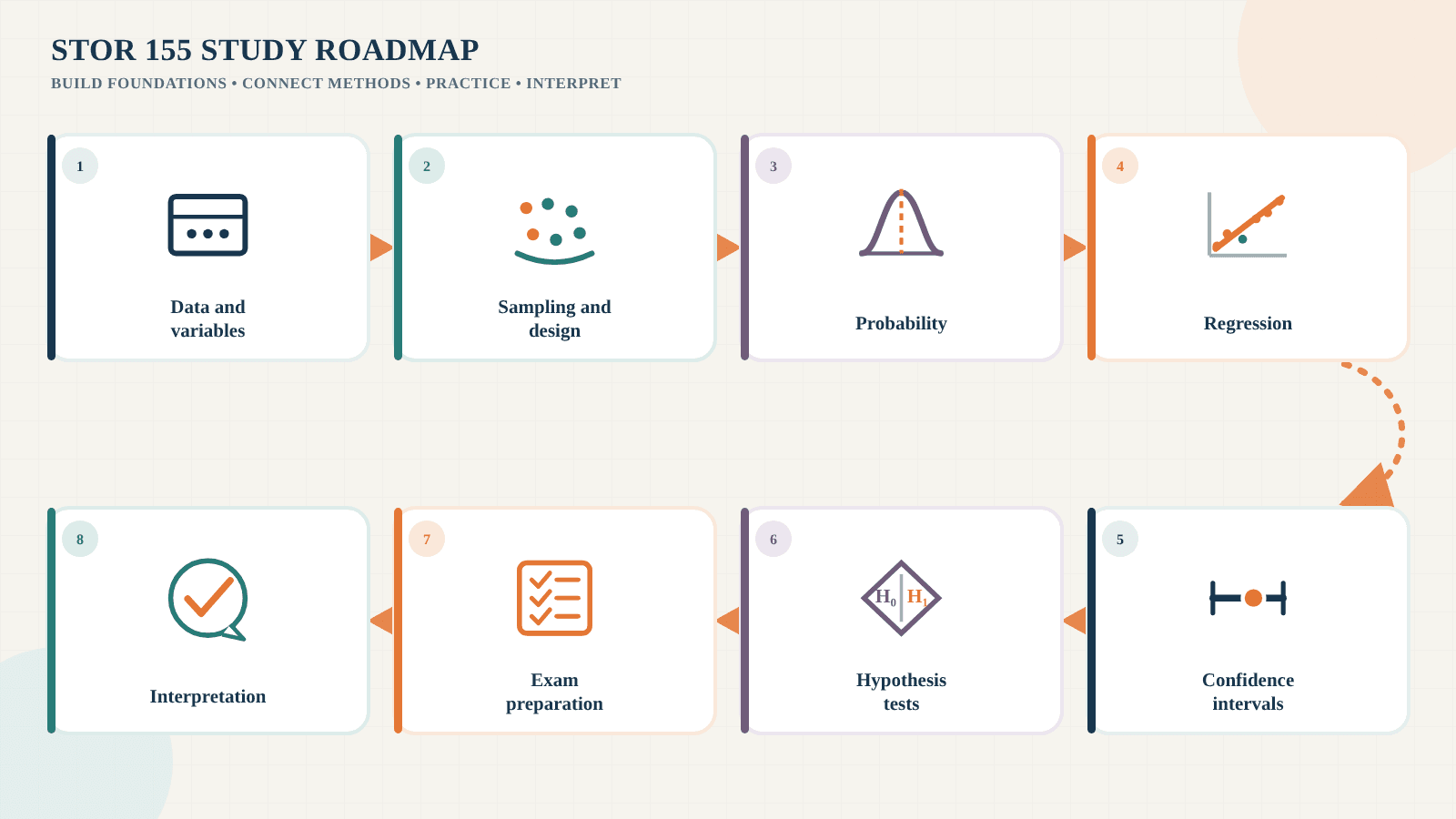
STOR 155 is UNC-Chapel Hill’s three-credit Introduction to Data Models and Inference course. It covers data analysis, sampling and experimental design, probability, correlation and regression, confidence intervals, hypothesis testing, and spreadsheet-based statistical work. This guide explains what students should expect, why the course can feel difficult, how STOR 120 differs, and how to prepare for exams without relying on leaked or section-specific materials.
The current UNC catalog lists MATH 110 as the prerequisite and describes STOR 155 as a letter-graded course with an honors version. Exact schedules, exam formats, and grading policies can vary by section, so use your current syllabus for instructor-specific details.
By DomyClass
Published:
At a glance
STOR 155 is a three-credit, letter-graded UNC-Chapel Hill course that introduces data models and statistical inference.
- Course
- STOR 155
- Official title
- Introduction to Data Models and Inference
- Institution
- UNC-Chapel Hill
- Credits
- 3
- Prerequisite
- MATH 110
- Grading
- Letter grade
- Software wording
- “Spreadsheet software”
- Honors
- Honors version available
- Core areas
- Data, design, probability, regression, intervals, and tests
- Difficulty
- Cumulative and interpretive (DomyClass analysis)
- Comparison
- STOR 120: different emphasis, four credits
Section details
Use your current syllabus
Start With What You Need
In This Guide
Chapter 1Understand STOR 155
What is STOR 155 at UNC?
STOR 155 is UNC-Chapel Hill’s introductory course in data models and statistical inference.
The official scope moves from describing data and evaluating how it was collected to probability, regression, confidence intervals for means, proportions, and regression parameters, and hypothesis tests. That sequence matters: an inferential calculation is only useful when the variables, study design, target population, and assumptions support the conclusion.
This page is an independent study guide, not an official syllabus. It summarizes stable catalog scope and provides a preparation framework; your current syllabus controls section-specific readings, deadlines, assessments, tools, and grading policies.
What topics does STOR 155 cover?
STOR 155 covers the complete path from understanding data and study design to probability, regression, estimation, testing, and interpretation.
STOR 155 topic families and focused follow-up resources
Topic family
Data and variable types
- What to understand
- Units, populations, samples, and variable types.
- Common difficulty
- Summarizing before identifying what a row represents.
- Deeper DomyClass resource
- Questions, data, and variable types
Topic family
Sampling and design
- What to understand
- Selection, assignment, bias, confounding, and valid conclusions.
- Common difficulty
- Confusing sampling with assignment.
- Deeper DomyClass resource
- Sampling bias and representativeness
Topic family
Probability
- What to understand
- Events, conditional reasoning, and chance models.
- Common difficulty
- Using a rule without defining the event or conditions.
- Deeper DomyClass resource
- How STOR 155 ideas fit together
Topic family
Random variables and distributions
- What to understand
- Expected value plus normal and binomial models.
- Common difficulty
- Misidentifying the random variable.
- Deeper DomyClass resource
- MATH120 statistics foundations
Topic family
Correlation and regression
- What to understand
- Association, line interpretation, residuals, and prediction limits.
- Common difficulty
- Treating association as causation or extrapolating.
- Deeper DomyClass resource
- How to read regression output
Topic family
Confidence intervals
- What to understand
- Estimate, uncertainty, parameter, and interpretation.
- Common difficulty
- Treating an interval as a range for observations.
- Deeper DomyClass resource
- Intervals, p-values, and effect sizes
Topic family
Hypothesis testing
- What to understand
- Null model, alternative, p-value, evidence, and decision limits.
- Common difficulty
- Treating a p-value as the probability the null is true.
- Deeper DomyClass resource
- Hypothesis testing in plain English
Topic family
Spreadsheet-based analysis
- What to understand
- Data, formulas, graphs, output checks, and interpretation.
- Common difficulty
- Trusting unchecked output.
- Deeper DomyClass resource
- STOR 155 course hub
How the STOR 155 topics connect
The topics connect as one evidence chain in which each decision constrains the next.
Question
Data
Design
- Study design
- Description
Model
- Probability model
Inference
- Regression or inferential method
- Uncertainty
Interpretation
If the design cannot support a population or causal claim, later calculations do not repair that limit. Use the conceptual STOR 155 guide when you need a fuller explanation of this chain.
Chapter 2Know What to Expect
Is STOR 155 hard?
STOR 155 is manageable for many students, but it can feel difficult because the topics build on one another and the course requires interpretation, not only calculation.
Why STOR 155 Can Feel Difficult
Difficulty varies by background, section, and study habits; no universal rating is reliable. Probability supports later inference, so missing that foundation can make intervals and tests feel disconnected.
Students also have to select a procedure, check whether it fits the design, read software output, and explain a result in context. Frequent practice with written interpretation is more useful than isolated formulas. No plan can promise a grade.
What Makes It Manageable
- One repeatable workflow
- Mixed practice
- Error log
- Interpret in context
- Review weak foundations
What is the difference between STOR 120 and STOR 155?
STOR 120 and STOR 155 are different introductory courses: the current catalog gives STOR 120 a four-credit statistics-and-data-science focus with programming, while STOR 155 is a three-credit data-models-and-inference course whose description names spreadsheet software.
STOR 120
Foundations of Statistics and Data Science
4 credits
STOR 155
Introduction to Data Models and Inference
3 credits
- Official title
- Separate identities and scopes.
- Credits
- Credit load is an official structural difference.
| Feature | STOR 120 | STOR 155 | What the difference means |
|---|---|---|---|
| Primary emphasis | Statistical and data thinking through programming and real datasets. | Data, design, probability, regression, intervals, and tests. | Both use data, with different catalog emphases. |
| Programming and data science | Explicitly included. | Not identified in the catalog description. | Do not assume identical workflows. |
| Statistics and inference | Includes statistical inference. | Names probability and inference topics. | Both include statistics. |
| Software wording | No product named in the catalog entry. | “Spreadsheet software.” | Check the current section syllabus for the required tool. |
| Prerequisite role | May substitute for STOR 155 for many STOR prerequisites. | May substitute for STOR 120 for many STOR prerequisites. | The FAQ says many, not all, STOR courses. |
| Program requirements | Listed for the current Data Science Minor requirement. | Accepted as an either/or option with STOR 120 in current Statistics and Analytics major requirements. | Prerequisite substitution does not imply universal equivalence. |
| Advising check | Confirm current program requirements. | Confirm current program requirements. | Use advising for registration or degree-audit questions. |
UNC introduced STOR 120 as an alternative introductory route, and the current Data Science FAQ says students may take both for credit. That does not determine an individual choice; confirm your degree, minor, prerequisite, and advising requirements.
What should students know before the first STOR 155 exam?
Students commonly need these foundations before later inference topics make sense.
Be able to identify observational units; classify variables; distinguish a population from a sample; evaluate data collection and sampling bias; separate experiments from observational studies; choose descriptive summaries and visualizations; explain correlation and regression foundations; and use basic probability language.
This is a preparation sequence, not a claim about the exact scope of a current first exam. Use your section syllabus and instructor materials to set the assessed boundary.
Data Structure
Define the unit, variables, population, and sample before calculating.
Study Design
Connect sampling and assignment choices to the conclusions the design supports.
Descriptive Reasoning
Read a graph or summary in context and flag unusual observations.
Probability Foundations
State what an association or probability means without adding a causal claim.
Chapter 3Prepare for Exams
How to study for STOR 155 exams
Study by practicing one repeatable reasoning workflow across mixed problems, not by memorizing each topic in isolation.
This is a DomyClass study workflow, not an official UNC rubric.
Phase 1 — Frame
Identify the question.
Name the target population, comparison, relationship, or decision.
Identify the observational units.
State what each row or measurement represents.
Phase 2 — Structure
Classify variables.
Mark categorical or quantitative variables and their roles.
Determine how data were generated.
Check sampling, assignment, missingness, and confounding.
Phase 3 — Select
Choose the relevant model or method.
Match the question, variables, design, and target.
Check assumptions.
Explain the conditions and consequences of a violation.
Phase 4 — Execute
Calculate or use software.
Keep inputs, units, formulas, and ranges reviewable.
Interpret in context.
Translate output into the language of the question.
Phase 5 — Validate
State limitations.
Bound population, causal, predictive, and precision claims.
Verify the conclusion.
Check direction, units, logic, and whether the design supports the wording.
Seven-day STOR 155 final-exam study plan
A focused seven-day plan should rebuild the topic sequence, require active practice, and end with mixed interpretation rather than seven days of rereading.
This plan is not a representation of an official UNC final exam. Adjust it to your current syllabus and remaining time.
Day 1 — Data, variables, and study designReview GoalReview units, variable roles, sampling, assignment, bias, and confounding.Open Day Plan
- Active-Practice Task
- Classify short study descriptions.
- Interpretation Task
- State the population and supported conclusion.
- Verification Check
- Check claims against the design.
Day 2 — Descriptive statistics and graphsReview GoalReview center, spread, shape, unusual values, and displays.Open Day Plan
- Active-Practice Task
- Read summaries for varied data types.
- Interpretation Task
- Compare groups with units and context.
- Verification Check
- Confirm the summary fits the variable.
Day 3 — Probability and distributionsReview GoalReview random variables, expected value, normal and binomial models.Open Day Plan
- Active-Practice Task
- Classify events and model conditions.
- Interpretation Task
- Explain a probability in context.
- Verification Check
- Check the event, range, and assumptions.
Day 4 — Correlation and regressionReview GoalReview scatterplots, lines, residuals, prediction, and limits.Open Day Plan
- Active-Practice Task
- Interpret slopes and residual patterns.
- Interpretation Task
- Describe direction, magnitude, and context.
- Verification Check
- Reject causation and unsupported extrapolation.
Day 5 — Confidence intervalsReview GoalReview estimates, standard errors, confidence levels, and parameters.Open Day Plan
- Active-Practice Task
- Interpret intervals for different targets.
- Interpretation Task
- State compatible parameter values in context.
- Verification Check
- Check units, parameter, level, and conditions.
Day 6 — Hypothesis testingReview GoalReview hypotheses, p-values, evidence, and practical importance.Open Day Plan
- Active-Practice Task
- Write hypotheses and conclusions.
- Interpretation Task
- Separate evidence from effect size.
- Verification Check
- Reject hypothesis-probability wording.
Day 7 — Mixed practice, error log, and interpretationReview GoalReview recurring errors.Open Day Plan
- Active-Practice Task
- Complete timed practice from authorized materials.
- Interpretation Task
- Write one full conclusion per method.
- Verification Check
- Correct each error and verify why.
Chapter 4Refresh Key Concepts
How to study probability for STOR 155
Study probability by defining the random process, event, and random variable before choosing a calculation.
Connect expected value to a long-run center and distinguish a model from observed data. For normal and binomial models, name the variable, check why the model could apply, and interpret the result in context. Probability supports inference because sampling variation describes what estimates and test statistics can do under a model.
Common mistake
Assumptions before arithmetic
How to prepare for regression questions
Prepare for regression questions by moving from the scatterplot to the fitted line, residuals, prediction limits, and a contextual conclusion.
Describe form, direction, strength, and unusual points before using a coefficient. Interpret slope as the predicted change in the response for a one-unit increase in the explanatory variable; interpret the intercept only when its input value is meaningful. Inspect residuals for patterns, keep predictions within the observed range, and remember that correlation does not prove causation.
Common mistake
Extrapolation and causation
Confidence intervals and hypothesis tests
Confidence intervals estimate a parameter with uncertainty, while hypothesis tests evaluate how compatible the data are with a specified null model.
For a test, state the null and alternative, interpret the p-value as a conditional probability under the null model, and describe the strength of evidence without declaring either hypothesis proven. For an interval, name the parameter, confidence level, units, and plausible range supported by the method. Statistical significance does not establish practical importance, so examine magnitude and context as well as evidence.
Common mistake
Evidence is not proof
Spreadsheet-based statistical work
Spreadsheet-based statistical work is useful only when the data, formulas, outputs, and interpretation remain auditable.
Preserve a raw-data copy, define variable roles, check missing values, inspect formulas and ranges, create graphs suited to the variables, verify important outputs independently, and translate results into context. The official catalog says “spreadsheet software” without naming a product, so the current section syllabus should determine the required tool.
Common mistake
Output still needs interpretation
- Keep raw data separate from cleaning and calculations.
- Make exclusions, transformations, ranges, and formulas reviewable.
- Check counts, units, graphs, and selected results before interpreting.
- Treat output as evidence to explain, not as proof by itself.
Common STOR 155 mistakes
The most common STOR 155 mistakes break the link between the study design, statistical method, and wording of the conclusion.
- Confusing a sample with the population it is meant to represent.
- Confusing random sampling with random assignment.
- Assuming correlation proves causation.
- Extrapolating beyond the observed data.
- Treating a p-value as the probability that the null hypothesis is true.
- Treating nonsignificance as proof of no effect.
- Treating statistical significance as practical importance.
- Trusting software output without interpreting or verifying it.
- Choosing a method before identifying the design, variables, and question.
Chapter 5Test Yourself and Continue
Original STOR 155 self-check
This six-prompt self-check tests reasoning and interpretation without reproducing or representing a current UNC exam.
Try each original prompt before opening “What a strong answer should mention.”
VariablesA campus survey records one row per respondent, weekly study hours, and preferred study location. Identify the units and classify both variables.Reveal What a Strong Answer Should Mention
What a strong answer should mention: respondents are the units; study hours are quantitative; preferred location is categorical.
Sampling BiasA sleep study recruits only students leaving an early fitness class. What limits a campus-wide conclusion?Reveal What a Strong Answer Should Mention
What a strong answer should mention: this convenience sample can underrepresent other schedules or habits, so selection bias limits campus-wide generalization.
Study DesignResearchers record caffeine use and quiz scores without assigning caffeine. Is this an experiment?Reveal What a Strong Answer Should Mention
What a strong answer should mention: it is observational because exposure was not assigned; confounding prevents an automatic causal conclusion.
RegressionA fitted line predicts 2.4 additional points for each extra hour of review. Interpret the slope carefully.Reveal What a Strong Answer Should Mention
What a strong answer should mention: within the observed range, predicted score changes by 2.4 points per added review hour; causation is not established.
Confidence IntervalsA confidence interval for a mean difference is 1.1 to 3.8 points. What should its interpretation include?Reveal What a Strong Answer Should Mention
What a strong answer should mention: identify groups, parameter, units, level, and method; describe compatible mean differences, not individual outcomes.
Hypothesis TestingA test produces a p-value of 0.04. Explain what that number does and does not mean.Reveal What a Strong Answer Should Mention
What a strong answer should mention: assuming the null model and test assumptions, a test statistic at least as extreme has probability 0.04; this is not a hypothesis probability or effect size.
Frequently asked STOR 155 questions
These concise answers cover stable course identity, preparation, difficulty, and the officially supported STOR 120 comparison.
What is STOR 155 at UNC?
It is UNC-Chapel Hill’s three-credit Introduction to Data Models and Inference course, covering data, design, probability, regression, intervals, tests, and spreadsheet work.
What is the prerequisite for STOR 155?
The current UNC catalog lists MATH 110 as the prerequisite for STOR 155.
Is STOR 155 hard?
It can feel difficult because topics accumulate and interpretation matters alongside calculation. Experience varies by student and section.
What topics are covered in STOR 155?
The catalog names data analysis, study design, probability and distributions, regression, confidence intervals, hypothesis testing, and spreadsheet software.
How should I study for a STOR 155 exam?
Use mixed practice: identify the question, units, variables, design, method, assumptions, calculation, interpretation, limitations, and verification.
How should I prepare for the STOR 155 final?
Follow your syllabus, revisit topics cumulatively, use authorized mixed practice, log errors, and rehearse interpretations. Do not assume a universal format.
What is the difference between STOR 120 and STOR 155?
STOR 120 is a four-credit statistics-and-data-science course with programming; STOR 155 is a three-credit data-models-and-inference course naming spreadsheet software. Program treatment can differ.
Does STOR 155 use Excel?
The current official catalog says “spreadsheet software” but does not identify a specific product. Students should check their current section syllabus for the required tool.
Is STOR 155 mostly probability or statistics?
It is a statistics and inference course where probability supports estimation and testing; probability is not the whole course.
Where can I get help with STOR 155?
Use the STOR 155 course hub and focused guides, current section materials, and official advising for program questions.
Related DomyClass resources
Use these related resources for course identity, prerequisite concepts, deeper statistical explanations, and further practice frameworks.
Featured Resources
STOR 155 course hub
Review the official course identity, broad scope, and course-specific help options.
How STOR 155 statistical ideas fit together
Follow the conceptual chain from study design and probability to inference and interpretation.
MAT-240 Applied Statistics
Explore applied regression, confidence intervals, hypothesis testing, and interpretation.
Foundations
- UNC-Chapel Hill course resources
Return to the university hub for available UNC-Chapel Hill course support.
- MATH120 Introduction to Statistics
Revisit introductory data, sampling, distributions, summaries, and uncertainty.
- Questions, data, and variable types
Practice defining observational units and classifying categorical and quantitative variables.
- Sampling bias and representativeness
See why selection methods determine which population claims a sample can support.
Inference
- MATH302 Statistics
Review probability, inference, assumptions, and statistical verification.
- DSRT 734 Inferential Statistics in Decision-Making
Connect study design and inferential choices to careful research conclusions.
- Hypothesis testing in plain English
Trace the reasoning from a null model to a bounded evidence statement.
- How to read regression output
Interpret coefficients, residual variation, model fit, and prediction in context.
- How to choose an inferential statistical test
Match a research question, variables, design, and target parameter to a defensible method.
- P-values, confidence intervals, and effect sizes
Keep evidence, precision, and practical importance distinct.
More Statistics Resources
- Can AI choose the right statistical test?
Use a verification framework when a tool suggests an inferential method.
- All DomyClass resources
Browse the complete directory of course hubs and focused learning guides.
Sources
Official UNC sources control course identity and program comparisons; NIST and ASA sources support the general statistical guidance.
- Statistics and Operations Research (STOR)
University of North Carolina at Chapel Hill Catalog, 2026–2027
- Undergraduate Courses
UNC Statistics and Operations Research
- New Courses for Undergraduate Students
UNC Statistics and Operations Research
- Students FAQ
UNC School of Data Science and Society
- Statistics and Analytics Major, B.S.
University of North Carolina at Chapel Hill Catalog, 2026–2027
- Data Science Minor
University of North Carolina at Chapel Hill Catalog, 2026–2027
- What Is Experimental Design?
National Institute of Standards and Technology
- How Can I Tell If a Model Fits My Data?
National Institute of Standards and Technology
- Confidence Limits for the Mean
National Institute of Standards and Technology
- ASA Statement on Statistical Significance and P-Values
American Statistical Association
Get Help With STOR 155 Introduction to Data Models and Inference at University of North Carolina at Chapel Hill
Get targeted STOR 155 help and improve your grades.
Get STOR 155 Help